
An Interview with Barbara Hammer
Barbara Hammer is a lesbian feminist filmmaker whose extensive filmography reaches back to the 1960s. Her work is held in the permanent collections of museums worldwide, including the Museum of Modern Art in New York City, the National Film Archive in Brussels, and the Taiwan National Film Library in Taipei. She received her Bachelors degree from the University of California Los Angeles and two Masters degrees from San Francisco State University. Her memoir Hammer! Making Movies out of Sex and Life (2010) is available from the Feminist Press at the City University of New York.
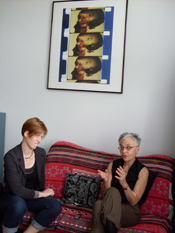
This interview took place in Barbara Hammer’s studio in New York City on May 17, 2010, and was conducted by members of the Films for the Feminist Classroom editorial collective: Deanna Utroske, Agatha Beins, and Karen Alexander.
Utroske In your own words, tell us who you are and what you do.
Hammer My name’s Barbara Hammer, and I’m an independent filmmaker. I’ve been working for 40 years, making about 80 experimental films, documentary films, lesbian feminist films—really, a wide variety of material in that time.
Utroske One goal of Films for the Feminist Classroom is to be a service to instructors, librarians, and scholars looking to use film in the classroom, whether as a primary text or as a supplement to other texts that they might be more familiar with.
I know that you’ve taught community-level classes as well as university-level classes. Your films and essays are being taught in classrooms. Could you talk about how film might make the feminist classroom a more productive place?
Hammer That’s a wonderful question. I find that using film in the classroom is a way of engaging the student body, and that people are very excited. We live in a media culture. If you put the means of production, the camera, in the hands of students, and give them some guidance but allow them to find their inner voice, you are going to have an attentive class: students will get there on time, students will be motivated and complete the work, and I think that is the key to education. It’s about tapping into the passion, and the students aren’t going to have passion if the faculty doesn’t have passion.
If you’re showing work to give the students an idea of what they might want to make or at least to educate them, we want to hear from the teachers exactly how they feel, why they’re committed, and why this is an exciting genre. And I really hope that faculty everywhere show three genres of film: the narrative, which is the story film and is the most well-known; the documentary, the “reality documentary,” not necessarily true, but one that looks at an event or place or a person; and then the genre that’s most maligned and least shown and most important I feel, the experimental film, film that plays with form as well as content. And all three of these genres need to be introduced and named so as to clarify the differences between them. Then the teacher can work from that base and show the experimental documentary, the experimental narrative, the cross-genre film, which is so popular today. By seeing and understanding the differences in film, the student is empowered. Empowering the students, that’s a feminist ideal.
In feminist therapy, where you didn’t lie out on the couch with Freud listening to everything you said and probably saying nothing back, the feminist therapist engaged with the client so to speak and was in an equal power relationship with the client. That’s what you want to have in the classroom. By letting the students, or encouraging them I should say, to come up with their own ideas and make their own work, you’re empowering them. You become a guide rather than, well, an authority figure that they might rail against. Although, everyone involved knows you still are an authority figure because of the structure of a classroom, because you’ve studied the subject extensively.
Utroske Thank you. My next question conceives of the classroom as a screening venue. You’ve talked elsewhere about how the circumstances of your film screenings or the audience makeup at film screenings mediate how a film is received, the sort of work it can do.
How do you suggest an instructor show a film in class? How might instructors take what you’ve learned from screening your films to audiences worldwide and apply it in the classroom?
Hammer Well, the traditional approach is to have a nice, quiet room with a projection booth, but probably most teachers won’t have that. So the projector might be a digital projector today, which would be inside the classroom. One thing you could do is have a student in charge of running the projector. That student’s trained before the class begins so that she knows how to run the machine. And that’s another thing you’d do, probably have a woman run the machine because of the bias that continues of men having the mechanical knowledge and women not having it. You would want to have the room dark and the sound nice and loud but not overwhelming. You’d want to follow the screening with a discussion while everything is fresh in the mind. You’d want to have some lead-in questions or statements about the film that might provoke the students; you might play devil’s advocate.
Once the students are used to a routine, you could show a more challenging film like my film, Available Space (1979). It could be projected on different places in the classroom. Use architectural space for projection. What would it be like to project on the ceiling? And talk to the students about what it feels like to be active when they watch it because they have to go like this [Hammer tips her head back to look at the ceiling]. Or maybe the projector could move to several places, and the students would have to move while they’re watching. Then you could ask, “How does that make you feel rather than just sitting straight in your seat?” I would use experimental approaches if I were showing experimental film especially. I would feel like I had the liberty to do that.
Utroske Great. Can you talk about your experience as a feminist teacher and if you separate that politically from your work making film?
Hammer Do I separate my feminist politics from making film, from teaching film? Do I compartmentalize my life? Well I’m on the faculty at the European Graduate School in Saas-fee, Switzerland. Last year I had a class, and the director [of the European Graduate School] doesn’t really want production to happen in the school. I’m teaching the documentary film, or I’m teaching queer cinema, or experimental cinema. Whatever I want to teach, I teach. I had a very astute group of students, six or seven, and one of them had brought a very nice, new HD Sony camera to class. He was off to shoot a film afterwards. One woman [in the class] teaches writing and is very keen on African-American cinema. In some areas the students had more knowledge than I have. One thing I do since I’m the teacher is turn the class over to the person with the most knowledge on the subject under inquiry. In this case, the young teacher led the discussion on Langston Hughes and on the documentary about Langston Hughes. After that seminar under student leadership and our inspection of the camera, we were all just dying to use the HD camera. We ended up making a film in class. A class that started out as a theory class became a production class, but we talked about theory as we worked. So the abstract and the practical merged.
We didn’t have time to edit the film, but several students decided that they wanted to edit it. I gave them a guideline and said you have to have it done before school starts. Our class was in June, so I said you have to finish by August, and then send us all Quicktime files. That gave structure. I knew that one student would begin teaching in September, so I asked her to get it done before her own students arrived. August came and lo and behold, there it was, something entirely different than I’d expected. They’d pulled clips from YouTube and Vimeo and collaged them with material we had shot in class.
The material we shot in class was guided by a particular workshop that I’ve developed over many years. I’ve named it Developing Personal Imagery, and I guide the students on a meditation that is body-focused and that becomes a film script. They draw an outline of their bodies. They see images in different areas. They draw those images. At the end of this several-hour class we have, hanging on the wall, the replica images of each of the students. Then we go through them, finding areas of similarity. And we start making the class script and film from that.
Utroske This spring you were touring to promote your book, Hammer! Making Movies out of Sex and Life (2010). Could you summarize your book tour and talk about how the audiences were different or similar from audiences that you encounter when you’re screening film?
Hammer I wrote a book last year, and it came out in March. It’s called Hammer! Making Movies out of Sex and Life. The publisher, the Feminist Press, set up a tour for me. So I screened the book, [laughs], I mean I screened the film! I’m so used to making films and not writing books that I actually performed the book. And this is quite unusual because I worked for 40 years and made so many films, and I have boxes of costumes and plenty of stories to tell. As a young feminist in the 1970s I wore costumes to my film screenings. I’ve kept my costumes, and I have an archive of them. I took about eight or nine clips from films that span from 1970 to 2008, and each of these clips is two to four minutes. I wear a different costume to introduce each one of those clips. On the stage we build a little changing room. While the clip is showing, say of an early film Menses (1974), a satire of menstruation, I’m inside the changing room putting on a Superdyke! T-shirt that I wore in 1975 along with the group of women, Superdyke!, who all wore the same T-shirts. Then we’d screen Superdyke! (1975). I’ll read about why I made Menses, that there was so much misinformation through the ages; for example, Pliny wrote that if a menstruating woman touches a pregnant mare her milk will go sour. There are all these old myths, but they influence us today. In 1973 the group of women I made the film with were in a PayLess drugstore ripping open Kotex boxes and coming out the doors swinging Tampaxes. Using humor was really important for me to reach the audience.
I don’t know if the book tour audience is any different than my film-going audience. People know me through my films. Here in New York I had a reading with Hilton Als. I hadn’t met him before. But of course I bought his book before we got together. This joint reading brought together a different audience because there were probably people who knew him but didn’t know me and vice versa. I liked that. He’s the theater critic for The New Yorker as well as an author in his own right. If you read his book The Women (1996), which was published 10 years ago, you will see that one-third of the book, and it’s a very small book at 110 pages, is devoted to his mother. It’s just beautiful writing.
Then Elizabeth Streb and I read together. She’s a choreographer who uses dancers’ bodies to test physics it seems. Slam-dance it’s called. She and I had a reading together. And that was very hot because we were both almost slamming against each other, verbally. And the audience was full of her followers. It was at Barnes and Noble, so that gave it an official bookstore setting.
I know that in Brussels they heard about the book tour performance I gave in London at the British Film Institute, and now they want me to perform at the Bozar Centre for Fine Arts, which I will do in October this year.
Utroske How did the opportunity for your upcoming retrospective at the Museum of Modern Art (MoMA) materialize? And could you talk about what preparations have gone into this project?
Hammer Well, I received a large grant from Creative Capital and made the film Resisting Paradigms (2003) about resistors during World War Two; they happen to all be women from the South of France. Creative Capital and I formed a long-term relationship, as they do with their artists. Even though the film was completed in 2003 I continued to work with them as a strategic planner. Strategic planning means you think about your time schedule, you think about what you want from something, and you make goals—one-year goals, five-year goals. You write your obituary so that by the time you do die you’ve been able to complete everything you wanted. I teach artists how to do this.
So I was very primed for wanting a retrospective of my work. And one Saturday night we had a screening at MoMA that introduced Maya Deren in a retrospective way to the public. Maya Deren is the mother of avant-garde film. Su Friedrich, Carolee Schneemann, and I have all been influenced in our filmmaking by Maya Deren. We showed three films of ours along with Maya Deren’s first film.
Sally Berger, the curator of Maya Deren’s Legacy: Women and Experimental Film, invited me many times to come to the museum for a dialogue about Maya Deren. Maya Deren influenced me: I had studied her while I was in school, I wrote a paper on her, etc. I felt like I was giving my knowledge away. Finally, one day I said, “You know what I really want?” And she said, “No, what?” And I said, “A retrospective.” She replied, “Well, I’ll take it to the films committee.” And then in about a week or two she came back and said, “They’re all for it.” Ask for what you want is the strategic plan. So many of us think we have to wait until we are asked. First I was embarrassed to say that I wanted a retrospective, but when I told the story other people were just so excited. It empowers us to think about what we want and to strategically plan how to get it.
September 15 is the opening night of my month-long retrospective of 15 different programs, each repeated. On October 4 I will give a talk called “The Hidden Hammer” about my lesser known performance, installation, and photography.
A retrospective involves a lot of watching films, planning, organizing, and then preparing with the most up-to-date media for exhibition. It has been a lot of work for the curator Sally Berger and for me as well. In that process, and along with the Maya Deren’s Legacy: Women and Experimental Film exhibition, the museum purchased about three or four films and videos of mine. There is also an artist fee that is provided, and the museum itself is paying for the restoration of several films as well as other film-related expenses. I am very happy with the arrangement and I’m very concerned about artists getting equal wages for their work.
Utroske You’re also being compensated in exposure via a prestigious retrospective.
Hammer I feel well compensated and I have the rent to pay! [Laughs] And the prestigious event happened because I’ve worked for forty years.
The organization Wages for Artists came up in conversation on my book tour. People in the audience would ask me what my feelings were about them. It is political. Artists aren’t paid; we’re professionals. And that’s pretty ridiculous, because we’re necessary for society.
Utroske Right. I’m wondering about the mentorship you receive: If you’re looking for guidance or inspiration, who do you reach out to? What community do you turn to for support? Who mentors you now?
Hammer [Laughs] Oh, my. Well, you know about Generations (Hammer and Carducci 2010) the film I’m working on now with Gina Carducci that’s about mentoring.
Who mentors me now? That’s a good question. Mostly I mentor myself, and in many ways I always have. But I have liked the work of Yvonne Rainer, Su Friedrich, and Maya Deren, of course. I looked at Meshes of the Afternoon (Deren 1942) the other day. I’ve seen it thirty times, and it’s still a new film every time I see it. So, work that I admire and respect mentors me.
In the Creative Capital world, the foundation supported by Andy Warhol money, Colleen Keegan has come to me as a strategic planner. Her training was with corporations. She has worked with MTV and with banks, teaching professional people how to strategically plan their lives. And she realized artists didn’t know how to do this. So she’s trained us, and now we go out and train others. I think I’m always learning in terms of professionalism. If there’s ever a really tough question, I’ll give her a call. It’s not about making art, but it’s about living my life as a professional artist.
Utroske You’re reaching out to a creative community of filmmakers that you’re drawing inspiration from, but professionally you’re reaching out to a different community, and I think that’s wise.
What sorts of work are you doing that you consider mentorship?
Hammer Well, because I’m seventy-one and have a large body of work and teach only once a year at the European Graduate School, I am interested in helping younger people or older people who are just beginning in film or video. I, by chance, ran into a woman who works at a film lab here in New York and found out that she had not made a film for five years. I asked to look at her film—it was very good, a film that she’d made in school.
I realized that if you work in the film industry it’s very hard to make art at night because you’ve been dealing with film all day long. You get paid for it. And your weekends need to be free. So I thought, this woman is not going to be able to make her own work unless she gets some inspiration. Being at a place in life where I have a reputation that’s very positive, I asked her if she’d like to work with me, thinking that our collaboration could help her get a start in the world as an experimental film maker. And we are collaborating on a film called Generations (Hammer and Carducci 2010)—she’s thirty-three, I’m seventy-one. We shot at Coney Island. Coney Island has been around a long time and is falling apart. As with age, you fall apart in some ways. We hand-developed the film so that pieces of the film fleck off, like my skin flecks off.
Now, the real creative approach to this mentoring, not just working together and shooting together, was coming up with an idea to release her into really seeing herself as an artist all on her own, so that she’s not going to need to collaborate with me on the next film. The idea that I had was that we take the same material, we copy it, and we both edit it separate from each other. So, we shot in 16mm. She worked with a lab that can translate 16mm film into digital files, so we have two copies. I have finished my edit digitally on a computer. She’s editing on a flatbed—the old, traditional, cut-and-paste way. That reverses roles in terms of age stereotypes. We’re not looking at each other’s work. We both have to make a film of fourteen minutes and thirty seconds. When we’re finished, we’ll put them together and decide which goes first. They’ll always be shown together, and the premiere will be at MoMA, September 15.
I feel terrific about being able to do that with one person. I’m hoping that other older filmmakers, or artists, or writers care about this. And even if they just choose one person to work with, they are giving back. I didn’t have children, you know. I made a lot of films, so maybe I have 80 children [laughs]. Through mentoring I get to have a personal exchange with someone else. And, of course in mentoring you learn as much as you teach. It really is more collaboration than mentoring.
Utroske Yes. Is there anything you’d like to share with the readers of Films for the Feminist Classroom that we haven’t talked about?
Hammer Recently I was in conversation at MoMA for their education department. And I’m going to consult for them on a class in experimental film that will be on YouTube. So I thought of feminist faculty. Anybody who has a computer should be looking for the class probably in 2011. I think we’re going to start working in the late fall next year, on an introduction to experimental film.
I also want to start something programmed more toward youth, with elementary school students, because I think they need the introduction to those three genres—experimental, documentary, narrative—very young. I’ve taken my films to a third-grade class; the students are eight years old. I’ve shown them films like Pools (Hammer and Klutinis 1981). I didn’t show any sexual films but films that were experimental. Pools is an underwater film shot at the Hearst Castle with Barbara Klutinis, and the students knew what it was about. We had a discussion afterward. Some were scared because they couldn’t swim. There’s a gold-painted ladder that we shot underwater, as well as above water, as a way to leave the swimming pool. “Why was it gold?” “Oh, because you can walk to heaven that way, or you can get to another place,” the students said. Well, “exactly, ladders always connected two different locations, maybe the spiritual and the earthly.” You could do anything with this information that came from a child. A class could be taught on making a film about ladders, using ladders as a metaphor. Each of the students would get to think how they want to use ladders. They could put them upside-down, sideways, on the floor—they could play hopscotch in them.
What I’d like to say is, as you introduce these films you put the means of production in the hands of the students. You can bring your class together, and things will organically grow. The next class will come out of the class you just had. You have the basic idea, but you don’t have to firm up a rigid schedule before you go into the semester.
If anybody wants to invite me to come to class and start them off or come for a particular part, I’d be happy to. And I’d love to see more films in the feminist classroom from the elementary level up through post-doc.
Utroske Thank you.