
Carol Jacobsen, activist, scholar, and social documentary artist, in conversation with Films for the Feminist Classroom
Carol Jacobsen’s films on women incarcerated in the United States are feminist classroom–ready. Many are short enough to be screened and discussed in one university class period. Her low-budget, vérité style makes the films accessible and intimate. Yet, they can be hard films to watch. Jacobsen documents jarring experiences of individual women as well as the broader human rights void where incarcerated women reside. And even once a film finishes, viewers know that women live in prison well beyond the 6, 10, 15, even 70 minutes that it takes to screen one of Jacobsen’s films, films she’s been making throughout her decades-long career.
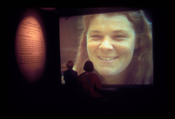
An artist, activist, and scholar, Jacobsen earned her bachelor’s and master of fine arts degrees from Eastern Michigan University, and she’s active with the Michigan Women’s Justice and Clemency Project. Her work has been shown, well-received, and won awards internationally. The photography and video installation “Mistrial” was cosponsored by Amnesty International in New York City (2011). Jacobsen won the Sarah Goddard Power Award for significant contributions to the betterment of women in 2010 and the Amigas Foundation’s award for activism and research on Clemency for Women Prisoners in 1995. Her films have appeared at the Strasbourg International Film Festival of Strasbourg, France (2009) and the OVNI International Film Festival in Barcelona, Spain, (2003), among others.
These credentials and accolades can seem to juxtapose Jacobsen’s grassroots approach and the intimacy of her films. She is a talented academic and a celebrated filmmaker and artist; yet her work extends beyond vérité filmmaking, beyond activist art, beyond accomplished scholarship, and beyond policy work. It is the day-to-day sum of her endeavors and the reach of her work that is valuable and powerful. True to form, Jacobsen sees to the reach (or distribution) of her films herself; we learn from the following interview that she personally mails out or hand delivers a number of films each week. And by doing so Jacobsen ensures that “citizens [can look] inside to see for themselves who’s in prison and why and also to see what the conditions are.”
My interview with Carol Jacobsen took place via email in the winter of 2010-2011 and benefited from the editorial input of Films for the Feminist Classroom co-Founding Editor Karen Alexander.
Utroske Much of your work centers on women in United States prisons. Why is this the issue you have taken as a subject of your artistic, scholarly, and activist work?
Jacobsen I was hooked in 1989, the first time I went inside a women’s prison. I was invited by Christina Jose, an activist who had organized a children’s visitation program at Huron Valley Women’s Prison, to make a film with the women inside. I made Our Children Do Time With Us (1990, 30 min.), which Dr. Jose used to raise funds to keep the program running. First, I was stunned to see myself in the faces and stories of the women who were serving time, especially those who had acted in their own defense against abusers and were now serving life. The criminalization of our experiences as women – lesbians, prostitutes, women who’d had abortions, been raped, or battered - was an injustice that resonated with my own shame-filled past, and I could not walk away. Second, I was deeply disturbed by witnessing the institutionalized dehumanization of the women. Prison is punishment by loss of freedom, confinement. I wondered how the institution, and the people running it, could so casually inflict cruelty, retaliation, and degradation on women in custody on top of that?
Utroske Can you describe your filmmaking process? (What kinds of decisions do you make in planning a film? What sort of equipment do you use? Do you work alone or with the assistance of others? What is the editing process like?)
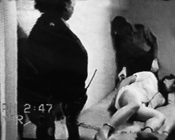
Jacobsen I make films out of a need to say what I wish to see and hear that is absent from the public sphere. When I made From One Prison… I was driven to bring people face-to-face with women inside in order to see and feel what I did and to hear the women’s social critiques of a criminal-legal system that failed them, that fails us all. With Sentenced (2002; 6 mins.), I wanted to make an homage to a woman I’d filmed and corresponded with who had committed suicide. I had not recognized her last letter as a goodbye, and I needed to respond to the loss that many of us – her friends inside and outside the prison - felt when she died. Some film ideas have been presented by the women who narrate them. Segregation Unit (2000; 34 mins.) was narrated by Jamie Whitcomb, who obtained footage, through subpoena, that was shot by guards of Jamie herself being chained down over and over. After she sued the State of Michigan for torture and won a settlement, she and I made the film. The women in Three on a Life Sentence (1998; 30 mins.) asked me to come into the prison and film their conversation about the injustices in their trials. Convicted: A Prison Diary (2006; 10 mins.) combined footage of a woman’s confession to police and excerpts from her letters to me over a period of a year. And for Time Like Zeros (2010; 12 mins.) I interviewed eight women who were recently released from prison.
I have worked with the same camerawoman, Susan Gardner, since 1992. She knows what I’m after in the shots and that I want extreme close-ups of faces for interviews. We used to shoot three-quarter inch tape and later on mini-DV tape. If I need footage that’s illegal or dangerous to obtain, I shoot it myself: for example, prison exteriors or certain neighborhoods at night in Detroit. On those occasions, I usually call my lawyer beforehand to let her know what I’m doing in case I get arrested! I do the editing myself, sometimes alone, other times with my colleague Shaun Bangert, who has coproduced several films with me, on Final Cut Pro. When I conduct an interview, I begin by telling the woman my own history: that I’m making a nonprofit film for a feminist audience, a film intended to educate and inform and to encourage participation in social change. I pay women for interviews, although I was not allowed to pay the women who were in prison. It bothered me that, although we were working together to get their voices out into the public sphere and speak together about the failure of the criminal justice system, the films did not help their individual cases. So I began working with them and with attorneys on clemency petitions, parole packages, and legal cases. Next I started bringing students and citizens into the prison with me and teaching university classes on human rights, women in prison, and activist practices. I have used all my films as educational and advocacy tools because I wanted my work to be part of a larger feminist political-legal-cultural movement for change. I am interested in creating face-to-face experiences for audiences to challenge the myths and misrepresentations of women lawbreakers that Hollywood and the corporate media produce. I’m invested in keeping my work grassroots, visually concise, nonprofit.
Utroske How does your training as an artist (a painter, to be specific) come to bear on your filmmaking?
Jacobsen When I was a figure painter in graduate school I was interested in depicting individual human experience within a political context. The figure was my primary subject, yet I wanted to include a narrative within the paintings. I studied “old mistress/master” painters such as Artemisia Gentileschi, Diego Velasquez and Edouard Manet for their overt and covert messages and meanings as well as for their formal, concise compositions and their skillful flair with the medium. I was also inspired by the work of Kathe Kollwitz, whose stark figure drawings and prints communicate both her passionate intellect and her social commitment to human dignity, and whose diary gave me insights into her motivations as an artist. I moved to photography and film/video because the “reality” and the technological aspects of those media allowed me to create a different kind of portrait with subjects who could speak for themselves. Since I write the interview questions and do the editing, we are, in a sense, speaking/working together through a contemporary medium that is powerful, immediate, “alive.” It is also very shareable.
Utroske Can you talk about the distinction between video and film (not literally in terms of physical material but practically in terms of each medium’s output)?
Jacobsen Film still produces the most beautiful image visually. But economically and temporally there’s no comparison. As Susan Sontag said about contemporary digital photography, it is an affordable, democratic, immediate medium that allows almost everyone to have a camera in their pocket and to produce images and voices that would otherwise be unheard, invisible. Hannah Arendt’s definition of freedom, as I understand it, is having access to speak and be active and heard in the public sphere.

Utroske Who do you consider your primary audiences, and what effects do you expect or hope your films will have on them?
Jacobsen My primary aim is toward a feminist audience, although my work is accessible to a broad audience as well. Some people ask about “preaching to the choir,” but I believe the choir needs booster shots of courage to keep up the struggle against the oppressive structures that resist and constrain women’s freedom. I know that I’m emboldened by the work of other feminists: artists, writers, activists, scholars. I need to see it, read about it, know about it. Together, we are a movement for feminist global change.
Utroske How your might your grassroots style of filmmaking, filmmaking with less Hollywood polish and more verité quality, bring your audience closer to the women in your films?
Jacobsen I’m dedicated to a grassroots approach that means a certain intimacy with the faces and voices on the screen. I care very much about the women I document and have built many lasting relationships. I’m after greater accessibility and immediacy for the audience to identify with these women who narrate my films. I’m not interested in traditional “voices of authority” giving information.
Utroske How do you see that your films reach audiences; how do you distribute your films?
Jacobsen I distribute them free to activists, educators, lawyers, and students worldwide. I mail or hand out from three to ten films a week from e-mail and lecture requests. There have been so few films available that are narrated by women prisoners that my films are in demand. The films are also screened at festivals and professional conferences worldwide, and shown in galleries and museums. Amnesty International and other human rights organizations, civil rights groups, domestic violence shelters, lawyers’ groups, students, community groups, and nonprofits also screen them and use them in various ways for fundraising, education, programming, etcetera.
Utroske Has any of your films seemed to have a more significant impact than the others? If so, can you talk about its impacts and why you think that particular film provoked such a reaction?
Jacobsen From One Prison… (1994; 70 mins.) has probably had the widest distribution. It toured worldwide with Human Rights Watch and won many awards. It is an in-depth social critique narrated by four women prisoners who give compelling and powerful analyses of the criminal justice and prison systems. Clemency (1997; 15 mins) has perhaps been shown most often since it’s a shorter film and so many activists and domestic violence centers and educators have it and repeatedly show it. Segregation Unit was the most painful film to make, and painful to watch, and I still wonder why I didn’t cut it shorter. It’s thirty minutes, and that’s too long. But I felt strongly about wanting the audience to know about the torture that goes on inside the deepest cells of the women’s prisons and to feel as outraged as I did. Jamie Whitcomb, who narrated the film, and I have protested together at the state capitol against the ongoing torture in Michigan prisons. A number of women in my films have continued to work with the Michigan Women’s Justice and Clemency Project after their release.
A very different film from the others is Censorious! (2005; 30 mins.) It’s a satirical piece narrated by women artists about their experiences with censorship. Shaun Bangert and Marilyn Zimmerman coproduced it with me. It was based on my 1991 article, “Redefining Censorship: A Feminist View,” in the Art Journal.1 Censorship has been an abiding issue in my work because of its proximity to women’s criminalization and because I’ve had to resist censors ever since I began documenting women in jails and prisons. In 1992-93, I fought a year-long battle against censors at the University of Michigan Law School for closing an exhibition of seven artists’ works, including mine (Street Sex 1989; 30 mins.), on prostitutes’ rights. We were represented by Marjorie Heins, of the American Civil Liberties Union Arts Censorship Project, and we won. The law school reinstalled the entire exhibit a year later (see Carole Vance, “Feminist Fundamentalism – Women Against Images,” Art in America, September 1993).
Utroske How might (documentary) film, as a text or technique, be taught to further prevent what you’ve called elsewhere (Signs 2008) the tendency that “mainstream news and documentaries have [to demonize] human beings who are in prison”?2
Jacobsen I’ve found that students are hungry to learn about human rights and to develop their own political critiques of issues such as women’s criminalization and institutionalized violence, misinformation, and corporate culture. Films are powerful vehicles for generating discussions. Now there are so many films/videos available, it’s hard, but important, to make critical selections.
Utroske In your 2008 Signs article, you also wrote, “I have found other ways to document the stories ... inside, which remain largely invisible to the general public.”3 Please share how distinct from and invisible to the public culture prison culture is.
Jacobsen Instead of critiquing the concept of punishment and the toxic prison industry as a whole, the corporate media demonizes human beings in prison. The Arts and Entertainment channel, Law and Order, and other television programs give a prejudiced, uneducated picture of the human beings inside. The mainstream news media focuses on pumping up stories of violence, when in actuality violent crime has not increased. Such fear tactics by the media collude with politicians’ election campaigns, and both the media and elected officials profit.
Prison culture is harsh and cruel because the state produces it. U.S. prisons infantilize women and retaliate against them illegitimately (especially if they file grievances or lawsuits) through petty tickets, invasive surveillance, discrimination (often against lesbians), psychological abuse, denial of self-development (programs are few and have long wait lists), refusal of human dignity (the “N” word, the “B” word, and other epithets are favorite insults hurled by guards), and subjection to harsh and filthy conditions, to starchy, revolting food, and to overcrowded cells. For those who suffer mental illness, the inhumanity is difficult to describe. Currently, there has been an epidemic of suicides and suicide attempts at Huron Valley Women’s Prison in Michigan as a result of the abuse by guards and the administration’s mishandling of the problem. Many young lesbians are being targeted for mistreatment by guards. Women have been confined to segregation, taunted and goaded, and chained down for hours or days at a time. I have written complaints to the Justice Department, Amnesty International, the governor, legislators, judges, and other policy makers to protest the inhumane treatment. There are investigations underway. I’m with Angela Davis: a system that is so broken, so corrupt, so obsolete must one day give way to the power of compassion and humane alternatives. But we have to keep pushing hard for it.
Utroske In what ways does physical and sexual abuse (such as domestic violence and violence against sex workers) contribute to the incarceration of women? And tell us how sexual abuse is exacerbated by incarceration.
Jacobsen Women abuse is an epidemic that is produced by governments worldwide. It is a leading cause of death among women, as well as the primary contributing factor in their lawbreaking. Most women are serving time for nonviolent, poverty-induced crimes. Many are criminalized only because they are women. Women working in prostitution, girls who are under duress from a male codefendant who commits a crime, domestic violence survivors, and poor women who write bad checks to support kids whose fathers are not held accountable by the law are some examples of gender-based crimes. Among women serving life or long sentences for murder in Michigan, approximately one-third acted in self-defense against an abusive male. And about 30 percent did not commit the crime at all but were with a male who killed someone, usually to their horror. Once they enter prison, women are vulnerable to the arbitrary violence of the institution. No individual abuser acts alone: laws, courts, jails, prisons, and other institutions normalize gender-based violence. In the 1990s, the U.S. Justice Department, Amnesty International, Human Rights Watch, and the United Nations all investigated Michigan’s women’s prisons and found the system to be one of the worst in the nation with regard to sexual assault, retaliation, medical neglect, and other human rights abuses against women. Last year, approximately four hundred courageous women prisoners and their lawyers won $100 million in a landmark class action lawsuit against the state of Michigan (Neal, et al. v. State of Michigan, et al.) for the rapes, assaults, and sexual abuses they had suffered for the past seventeen years. Because of the women’s lawsuits and grievances and other acts of resistance, they had also suffered unspeakable retaliation and cruelties over the years, which continue today. Women are harassed, locked down, and given petty tickets to delay their paroles; they can no longer wear street clothes (which might “tempt” male guards); the library space was taken away (only a small law library, required by law, remains, with endless restrictions for its use); and the media ban effectively cuts off the women from direct contact with reporters. In a closed system like prison, abusive keepers take advantage of the women with impunity.
Utroske Can you speak concretely about how women in prison are denied opportunities for communication?
Jacobsen All recording devices, including cameras and audio recorders, are banned. Reporters are routinely denied entry and therefore have a difficult time getting access to interview women inside. Scholars are also routinely denied permission to conduct research studies in prison, especially with women. Prisoners must wait in lines for the few available phones to make collect phone calls, or call on their purchased phone cards, and are allowed to call only persons on an approved, limited list. Visitors are also limited. A prisoner may receive visits only from a certain number of nuclear family members and friends, who must also be cleared by the state. A visitor may be on only one prisoner’s list. It is only attorneys and their assistants who can meet with more than one prisoner in the state. (There are occasional exceptions for those who have more than one incarcerated family member.) Each time I visit a prisoner (as a legal assistant), I take a student or volunteer with me because I want to get as many citizens inside to see for themselves who’s in prison and why and also to see what the conditions are.
Utroske Talk about how the silencing of prison life and sexual violence lets incarcerated women be overlooked and about ways that your work (in the classroom, in film, as an activist) can facilitate conversations about these hushed issues (or cultural taboos).
Jacobsen As a closed system that most people do not see and cannot enter, the prisons in our midst are virtually invisible. Women prisoners, in particular, are forgotten because they comprise only about 7 percent of the total prison population and are seen as an insignificant population by policy makers, despite the fact that women’s incarceration rate has increased dramatically over the past thirty years due to the war on crime and drugs, which has ensnared too many poor women instead of kingpins of drugs and violence. The silencing and misrepresentation by the corporate media compounds the problem. Films in which women prisoners speak for themselves about the injustice of their trials and the conditions of their incarceration open opportunities to present a different picture of women’s “crimes.” The audience can hear how women’s acts of survival turn them into criminals; how issues of abuse and other facts of the cases are absent from trials, how most women did not testify for themselves or were convinced to take pleas to avoid life sentences (when they should not have gone to prison at all), how gendered, racist, and inhumane prisons are, etcetera. The audience can almost feel the pressure-cooker conditions that women are forced to live in when these issues are openly discussed. They can hear about women’s acts of resistance and ways of supporting each other. While men often turn their anger toward each other and assault other men in prison, women prisoners often form family structures to help each other, but also frequently turn their anger inward and become suicidal. There has been a rash of suicide attempts and at least four actual suicides in the women’s prison in Michigan in the past year due to the contemptuous attitudes of the prison administration and brutality of the staff and because of the crowded, unsanitary conditions. The women’s lawsuits, i.e., Nunn, et al. v. Michigan Department of Corrections, et al., Civ. No. 96-CV-71416-DT; and the U.S. Justice Department’s lawsuit in support of the women: United States of America v. State of Michigan, et al., Civ. No. 97-CV-71514-DT, brought a few changes: male guards are no longer assigned to housing units, toilets, or showers; this makes it more difficult, though not impossible, for them to assault the women. But some guards have found other ways (threatening misconduct tickets, brutality, name calling, refusing medical help, and other degrading and malevolent behavior) to harass the women over the lawsuits. And the Department of Corrections retaliates by taking away more “privileges,” such as requiring women to wear uniforms that must be uncomfortably tucked in at the waist, putting limits on commissary items, refusing entrance to volunteer programs by American Friends Service Committee or domestic violence centers, etcetera.
One woman in the Michigan Women’s Justice and Clemency Project who was paroled recently after twenty years in prison was hospitalized within hours because she collapsed from several neglected medical conditions. She said the doctors and nurses in the emergency room were lined up at her bedside grilling her about prison life and were astonished to find how neglected the prisoners’ medical and dental needs are, how little and non-nutritious the food is, how difficult it is to take care of basic needs, because items like soap have to be paid for despite the fact that most prisoners come from poor backgrounds and jobs are few in prison. Bringing former prisoners to lecture in classes is an eye-opening experience for students. When I brought a friend in to speak in a university class on LGBT issues, students heard firsthand about her experience as an out lesbian in prison. She had been classified as a “predator” by the Michigan Department of Corrections and confined to segregation for her first year in prison. She was also targeted by some of the guards for harassment and issued false tickets that resulted in her serving a longer prison sentence. The current harassment of young lesbians and young mentally ill women in Michigan’s prison is under investigation by the Justice Department.
Utroske Could you please refer (or link) to a few supporting resources that would be helpful to instructors teaching about the connection between sexual violence and incarceration?
Jacobsen Here are a few sources:
The Amnesty International Report “Not Part of My Sentence”: Violations of the Human Rights of Women in Custody documents the abuses suffered by women in custody in the United States, including sexual assaults by staff, medical neglect, and other atrocities. http://www.amnesty.org/en/library/info/AMR51/001/1999
This American Civil Liberties Union page, http://www.aclu.org/womens-rights/words-prison-sexual-abuse-prison, lists lawsuits by the ACLU in connection with women’s unjust convictions and abusive treatment during incarceration.
The National Center on Domestic and Sexual Violence site http://www.ncdsv.org
/publications_prisonabuse.html lists a number of publications on battered women in custody.
The Human Rights Watch Report All Too Familiar, http://www.aclu.org/hrc/
PrisonsStates.pdf , is a report on sexual abuse of women in U.S. state prisons.
Women’s Prison Association is a resource for information on the subject of women in prison. http://www.wpaonline.org/pdf/Quick Facts Women and CJ 2009.pdf
Utroske You have described yourself as a social documentary artist. What does that mean to you and to the way your work is categorized or encountered?
Jacobsen It is a cultural term that distinguishes traditional documentary from an engaged and activist documentary practice. Cultural critics such as Martha Rosler, Patricia Zimmerman, Alexandra Juhasz, Lucy Lippard, Nina Felshin, Carol Squiers, Deborah Willis, Carole Vance, Sidonie Smith, and others have written about feminist, grassroots, and social documentary film/video/photography/cultural practice.
Utroske You work as an activist, with groups like the Michigan Women’s Justice and Clemency Project; as a professor, with the University of Michigan; as an artist, represented by the Denise Bibro Gallery in New York City. These roles seem discrete yet carefully intertwined. Can you talk about the relationships among your work as an activist, as a scholar, and as an artist?
Jacobsen I work at integrating and balancing these roles because they are interdependent in my life, personally and professionally. I have built lifelong friendships with feminists on both sides of the fence. Activism on this issue means participating in a large feminist/social justice movement that changes at a glacial pace and is deeply frustrating and often depressing. Individually, we have achieved only a handful of actual releases among hundreds of deserving women after twenty years: four clemencies and two court releases for lifers in first-degree murder cases; four paroles for lifers in second-degree murder cases; and a dozen paroles in cases of women who had terms of years. I might have burned out if it were not for my work as an artist, teacher, and writer, which provide access to various feminist communities, opportunities to express my views publicly, and rejuvenation through sharing work and courage with other feminist artists, scholars, attorneys, activists.
Utroske Once someone (say, a student who just watched From One Prison…) is interested in (feminist) activism or human rights work, what are first, next steps for engaging with the issue of incarcerated women?
Jacobsen It’s important to do homework, take classes, and read as much as possible on the issues involved to get grounding and confidence and ideas for action. Nonprofits always need volunteers: find out if domestic violence centers, women’s organizations, and others are involved with this issue. American Friends Service Committee, the American Civil Liberties Union, Amnesty International, and Human Rights Watch are some examples of organizations that do work on behalf of prisoners’ rights. At the University of Michigan, the School of Social Work, the Law School, the Sociology Department, and the English Department offer classes that go into the jails and prisons, mostly men’s. My friend and colleague, Dr. Lora Lempert, organized all-volunteer college classes in the women’s prison (teaching college classes to incarcerated people is illegal in Michigan, but she achieved this miracle by raising funds herself, persuading professors to volunteer teach, and getting support from legislators to back her). In December 2010, the first woman who began college classes inside that Dr. Lempert organized was able to finish her course work and graduate from the University of Michigan–Dearborn outside of prison. The Domestic Violence Center in Ann Arbor finally got permission in 2010 to run two domestic violence classes in the women’s prison—something we’ve struggled for years to accomplish. One volunteer student with the Michigan Women’s Justice and Clemency Project took it upon herself to collect books to build up the library in the women’s prison. A surgeon who volunteered for several years with the Clemency Project is now a volunteering physician in the men’s prisons. Some students take paralegal courses to volunteer with criminal defense attorneys. It’s critical that citizens keep pounding on prison walls to get in, think up new pilot programs, work with nonprofits, attorneys, domestic violence professionals and others, and band together—and not give up! It is business-as-usual for prisons to deny entry to citizens and scholars, but it’s important to keep trying. Women prisoners especially are hungry for education, domestic violence programs, therapy programs, vocational training, and other assistance, and they have far fewer programs than men prisoners do. The college program and the domestic violence groups here at Huron Valley Women’s Prison have wait lists of several hundred women each.
Utroske How do you see your work in relation to written texts on the subject of incarcerated women? And how do the two (the film and the written scholarship) function together in the classroom?
Jacobsen My work is guided, expanded, deepened by feminist theory and writings in law, social work, sociology, visual culture, and other disciplines. I screen my own and others’ films in classes as a basis for discussion, and I assign readings and research so that the visual, written, and theoretical work augment each other, and even become theory-in-practice.
Utroske Can you please recommend the work of other filmmakers, activists, or scholars, whose work might complement yours in the classroom? Or, what resources, specifically, might instructors teach alongside your films?
Jacobsen Some of the activists and scholars that I present in my classes include the scholar Angela Y. Davis, who is a prisoner rights activist and prison abolitionist; Lucy Lippard, the cultural critic on activist art; Sidonie Smith, a writer/scholar on feminist autobiography and human rights; Marjorie Heins, a lawyer/scholar/activist and founder of the Free Expression Policy Project; Carole Vance, a writer/scholar/activist who writes on culture wars and sexuality; Ann Snitow, a writer/scholar/activist who writes about the U.S. and international feminist movement.
Among the artists I discuss are Paula Allen, whose photography focuses on “outsider” groups of women in various parts of the world; Lourdes Portillo, filmmaker, who directed Senorita Extraviada on the murders of women in Juarez; Holly Hughes, performance artist/writer on lesbian sexuality; Danielle Abrams, performance artist who addresses race, lesbian sexuality and ethnicity; Rhodessa Jones, performance artist/writer on activist theater with women in prison; Donna Ferrato, whose photography book, Living with the Enemy, is a classic on domestic violence; The Guerrilla Girls, activist artists who call themselves “the conscience of the art world;” Carol Leigh a/k/a Scarlot Harlot, performance artist/writer/activist on prostitutes’ rights; Pat Ward Williams, whose photography examines issues of race and gender; Tequila Minsky, New York photographer/activist on Haiti; Marilyn Zimmerman, photographer/activist who documents Detroit; Connie Samaras, Los Angeles photographer/writer who critiques corporate, military and political cultures; Clarissa Sligh, Philadelphia photographer whose work addresses race and gender. And many more.
Utroske Please describe your current or next film project.
Jacobsen Currently, I’m working on a film with Shaun Bangert about street prostitution in Detroit. I made Street Sex more than twenty years ago, and I wanted to take a look at what’s happening with women street workers in Detroit now. After I sat in prostitution court for several days, Judge Leonia Lloyd invited me to meet with her, and later she allowed me to film in her courtroom and to interview women in her office. She is truly a force for change, and it’s an inspiration to watch her in action. She cares deeply about the women who come before her and spends hours on the bench talking with them, encouraging and praising their progress. She is a model for other judges who could learn from her about humanizing their positions as public servants. I’m still sorting out my concerns about jailing the women, however. Jails are not the answer: we need drug treatment, education and vocational training, housing, and other economic and support programs built into the public system for women.
Utroske What sort of encouragement can you give to artists who aspire to do outreach with their work, who aspire to make pivotal activist art (film or otherwise)?
Jacobsen It’s deeply rewarding to create your own role as an artist and/or activist in the world and in ways that allow you to participate in change locally, nationally, globally at whatever level(s), for whatever issue(s) you feel strongly about and in whatever way(s) you can. The world needs you!! And the art world needs you!!!
Notes
1 Carol Jacobsen, “Redefining Censorship: A Feminist View,” Art Journal, Winter 1991: 42-55.
2 Carol Jacobsen, “Creative Politics and Women’s Criminalization in the United States,” Signs: Journal of Women in Culture and Society, 33(2) 2008: 464.
3 Carol Jacobsen, “Creative Politics and Women’s Criminalization in the United States,” Signs, 33(2) 2008: 465.